
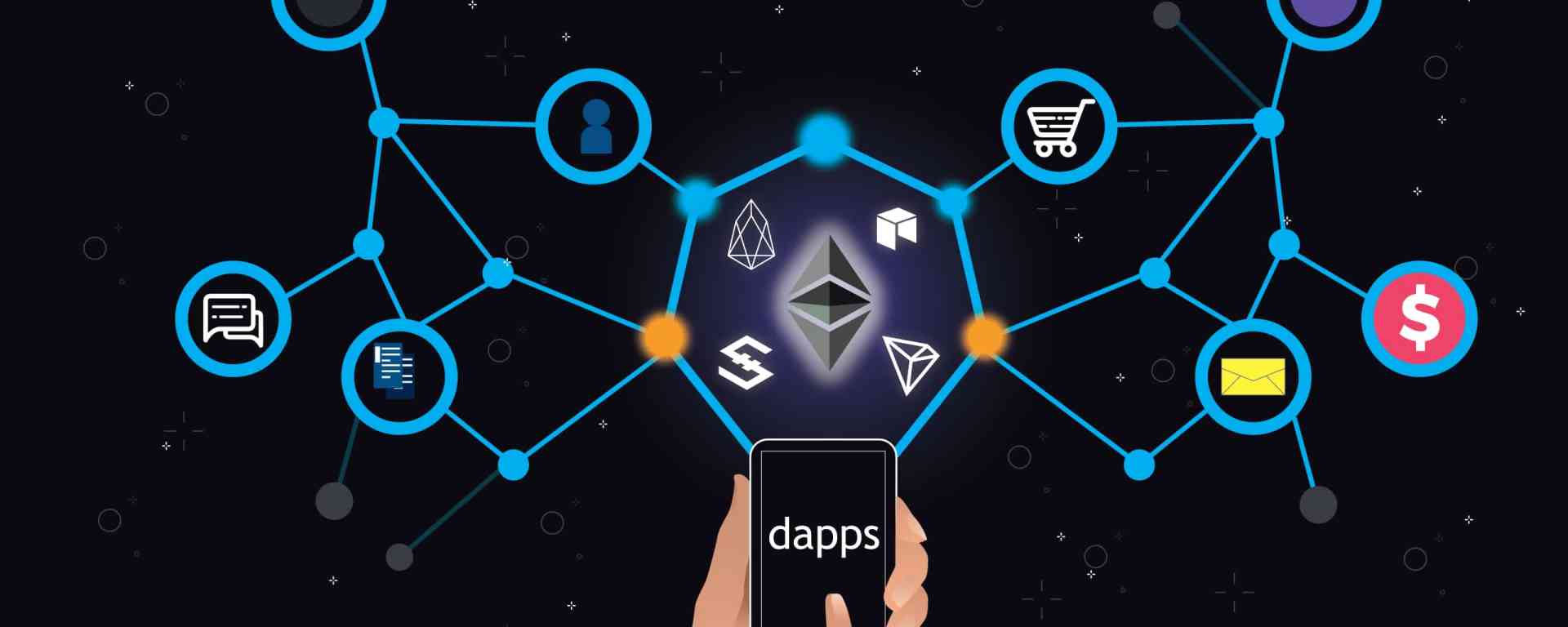
Embark on a journey to the cutting edge of technology with decentralized applications (dApps), where blockchain power transforms trading, lending, collecting, and saving into secure, transparent experiences free from traditional intermediaries. Through platforms like Uniswap, Aave, OpenSea, and PoolTogether, dApps invite you to explore new possibilities in digital interaction. Whether revolutionizing how we trade, redefining lending, unlocking the world of digital collectibles, or turning savings into an exciting lottery, dApps are reshaping our digital world, offering a glimpse into a future fuelled by innovation and user empowerment.
What is a Decentralized Application?
A decentralized application (dApp) is a software application that runs on a decentralized network, typically built on blockchain technology. Think of a dApp as a city, where the infrastructure (the blockchain) is like the roads, bridges, and buildings that make up the city.
Just like a city, a dApp has its own rules and regulations which are smart contracts that govern how things work, and these rules cannot be changed by a single entity as opposed to a centralized app, where one company or organization controls everything. In this city, every person (node) has equal power and a copy of all the information (ledger), so there is no need for intermediaries or a central authority to make decisions. This creates a more secure and transparent system, where everyone has a say and no one person can manipulate the data.
It is also important to note that dAppps cannot be shutdown easily because they run on a decentralized network. This is because rather than running on one central server they are ran on multiple nodes, making it extremely difficult to alter or shutdown the application.
In a decentralized app, users interact with the applications through their cryptocurrency wallet rather than through a traditional account system that requires an email address and password. This is because a decentralized app operates on a decentralized network, where each user’s information is stored in a secure and encrypted manner on the blockchain. The user’s wallet acts as their digital identity, allowing them to access and interact with the decentralized app and its features, as well as securely store and manage their cryptocurrency asset
Use Cases for dApps
The realm of decentralized applications (dApps) holds immense potential for solving various real-world challenges. Like centralized applications, dApps can address a diverse range of functions and industries including finance, social media, health, betting, and trading, to name a few. Currently, there are numerous dApps in use, each offering innovative solutions for different needs.
- Decentralized Exchanges (DEXs): These are peer-to-peer marketplaces where users can buy and sell cryptocurrencies without the need for intermediaries. They provide increased security, privacy and control over funds.
- Decentralized Prediction Markets: Decentralized prediction markets are platforms where users can bet on the outcome of events and make predictions about the future. They provide an efficient and transparent way of aggregating information and incentivizing accurate predictions.
- Finance: dApps can be used as a peer-to-peer method for financial transactions, for example the exchange of currencies or the transfer of assets. They may also be used as a method of monetizing digital assets.
- Decentralized Social Media: Decentralized social media platforms provide users with more control over their content, data and privacy. They use blockchain technology to create a transparent and tamper-resistant environment for social interaction and communication. Examples include Steemit, Minds, and Voice.
Top 5 Decentralized Applications
1. Uniswap
What is Uniswap?
Uniswap is a decentralized Exchange (DEX) that runs on the Ethereum blockchain that facilitates trading for ERC20 tokens. Uniswap is decentralized meaning that the trades made on the platforms occur without the need for a central authority or intermediary. Most exchanges are created for the purpose of taking trading charges, however because Uniswap works for public welfare, Uniswap members can exchange tokens easily and cheaply by removing the need of paying any platform charges, or dealing with negotiators.
Another important factor to look at when using Uniswap is the ability to access and trade a wider range of assets such as Non-Fungible tokens (NFTs) alongside ERC20 tokens which can then be used in Decentralized Autonomous Organizations (DAOs), with uses ranging from investing to betting and much more.
Using Uniswap?
To use Uniswap, you need to connect a wallet to the platform. Here’s how:
- Choose a compatible wallet: Uniswap is supported by several types of wallets, including software wallets such as MetaMask, hardware wallets like Ledger, and mobile wallets like Trust Wallet.
- Connect the wallet: Once you have chosen a wallet, you need to connect it to Uniswap. This can be done by navigating to the Uniswap website and clicking the “Connect” button. From there, follow the steps to link your wallet to the platform
Once your wallet is connected, you can start trading on Uniswap by selecting the token you want to trade and specifying the amount you wish to trade. Uniswap will automatically match you with a buyer or seller, and the trade will be executed automatically. This decentralized Application acts as a DEX in this case providing users the opportunity to trade their tokens.
Check out the full guide on settingup and using Uniswap here.
2. AAVE
What is AAVE?
Aave is a dApp platform built on the Ethereum blockchain that allows users to deposit and borrow cryptocurrencies in a decentralized and trustless manner. In simple terms, Aave is like a digital bank where you can deposit your cryptocurrencies, earn interest on your deposits, and borrow other cryptocurrencies if you need them.
The key difference is that Aave operates on blockchain technology, making it decentralized and open to anyone with an Ethereum wallet. This means that there is no central authority controlling the platform and users have full control over their funds. With Aave, you can access a wide range of financial services, from earning interest on your digital assets to borrowing against them, without the need for traditional intermediaries.
Using AAVE?
Using AAVE is relatively simple. First, choose a compatible wallet like MetaMask, Ledger, or Trust Wallet. Then, connect your wallet to Aave by navigating to the Aave website and clicking the “Connect” button. After connecting, you can deposit funds into Aave by choosing the cryptocurrency you wish to deposit and following the steps to send the funds to Aave’s smart contract.
If you need to borrow funds, you can do so by selecting the currency you wish to borrow and specifying the amount. Once you have repaid your loan, you can withdraw your remaining funds from Aave. It is important to consider the terms and conditions of a loan before borrowing, including the interest rate and repayment terms, and be aware of the risks involved with DeFi platforms.
3. OpenSea
What is OpenSea?
OpenSea is a decentralized marketplace for digital assets like collectibles and virtual real estate. It operates on the Ethereum blockchain as a decentralized application (dApp). Transactions on OpenSea are secure, transparent, and resistant to censorship and fraud. Users can buy, sell, and discover unique digital assets on the platform.
Using OpenSea?
To use OpenSea, first choose a compatible wallet such as MetaMask, Gnosis Safe, or Portis. Connect your wallet to the platform by going to the OpenSea website and clicking “Sign In”. Browse the available digital assets, including collectibles, gaming items, and virtual real estate.
To buy an asset on OpenSea, click on the desired asset and follow the steps to make the purchase. If you want to sell an asset, list it on OpenSea by specifying the details, including the price. OpenSea also provides a portfolio management tool to view and manage your assets and their transaction history.
4. Compound

What is Compound?
Compound is a financial decentralized application (dApp) built on the Ethereum blockchain that offers an alternative to traditional banking. It provides a decentralized and trustless way for users to earn interest on their crypto assets and access loans backed by their digital assets. Compound leverages the security and transparency of blockchain technology to offer a secure, transparent, and accessible platform for users to manage their digital assets.
Using Compound?
To get started with Compound, you’ll need to choose a compatible wallet, such as MetaMask, Gnosis Safe, or Portis. Once you have chosen a wallet, navigate to the Compound website and click the “Connect Wallet” button. This will allow you to link your wallet to the platform.
Next, you can deposit your crypto assets into the Compound platform to start earning interest on them. Your assets will automatically start accruing interest based on the platform’s interest rate mechanism. If you need to borrow assets, you can do so using your crypto assets as collateral. Simply select the asset you want to borrow and specify the amount. The platform will automatically calculate the amount of collateral required. You can easily view your assets, see your transaction history, and manage your investments all in one place with the user-friendly interface.
5. PoolTogether
What is PoolTogether?
PoolTogether is a decentralized application (dApp) that allows users to pool their funds together and enter into a lottery-style draw for the chance to win a large interest-earning prize. Essentially, it’s like a savings account that also gives you a chance to win big. Participants in the pool each deposit a small amount of money into a collective pool, which earns interest over time. At the end of each cycle, the interest earned is awarded to one lucky winner.
Think of it like a savings account that offers a little extra excitement, as you have the chance to win a larger sum of money, but still save and earn interest on your funds. It’s a simple way to save and potentially win big, all while taking advantage of the security and transparency offered by blockchain technology.
Using Pool Together
Here are five steps on how to use Pool Together:
- Choose a compatible wallet: Pool Together is compatible with various types of wallets such as MetaMask, Gnosis Safe, and Portis. Choose the wallet that works best for you.
- Connect your wallet: Navigate to the Pool Together website and click the “Connect Wallet” button. Follow the steps to link your wallet to the platform.
- Deposit funds: To enter the lottery, simply deposit your preferred amount of funds into the Pool Together platform.
- Join the pool: Once you have deposited funds, you will automatically be entered into the lottery draw.
- Wait for the draw: The draw takes place at the end of each cycle. If you’re the lucky winner, you’ll receive the interest earned from the collective pool. If not, your funds will remain in the pool and continue to earn interest until the next draw.
Another amazing feature is that you can withdraw your funds from Pool Together at any time. Simply navigate to the platform’s interface, select “Withdraw,” enter the desired amount, and confirm the transaction on your connected wallet, which will then transfer the funds to your wallet’s address. Please note that there may be certain conditions or fees associated with withdrawing your funds, so it’s important to familiarize yourself with the platform’s terms and conditions before using the service.
Final Words
Decentralized applications (dApps) are online platforms that operate on a decentralized network, using blockchain technology to offer users a range of services and features. Uniswap is a decentralized exchange that allows users to trade cryptocurrencies in a trustless and transparent manner. Aave is a decentralized lending platform that enables users to earn interest on their digital assets. OpenSea is a decentralized marketplace for buying, selling, and discovering unique digital assets. Pool Together is a decentralized application that allows users to pool their funds together and enter into a lottery-style draw for the chance to win a large interest-earning prize.
Setting up and using dApps is relatively easy, as it typically only requires a compatible wallet, without the need for any personal identification. This makes dApps a convenient and secure option for managing digital assets. However, it’s important to be aware that dApps are still a relatively new technology and can be subject to high volatility, so it’s important to carefully consider all of the terms and conditions before using any dApp
 Wondamo