
In the thrilling world of tech, no competition ignites more intrigue than a face-off between industry titans such as Elon Musk and Mark Zuckerberg. Their latest battleground? The complex terrain of social media. The primary weapons? Twitter, Musk’s favourite digital soapbox, and Instagram’s latest venture, Thread. This high-stakes duel is more than just a personal feud—it’s a monumental shift in social media dynamics. Today, we’re delving deeper into this exhilarating face-off, dissecting how Thread intends to challenge the dominance of Twitter.
Table of Contents
What is Thread? A New Contender Emerges
On July 6th 2023, Instagram, a subsidiary of Zuckerberg’s Facebook empire, redefined the social media arena with the revamped version of Thread. This reimagining of the original Thread app launched in 2019 marks a significant shift in Instagram’s approach to digital connections.
Thread was not created to simply be another messaging app. With its focus on being a ‘camera-first’ app, it allows users to share photos, videos, and messages with a specially selected group of Instagram’s “Close Friends”. This move is a deliberate deviation from Twitter’s approach of global broadcasting, instead highlighting a focus on intimate, personal connections.
Thread’s successful launch was, in part, due to Instagram’s strategic use of its existing network. By intertwining its functions with Instagram, Thread was able to attract an astounding 10 million users within just seven hours of its launch. This impressive feat underscores the potency of Instagram’s platform and the compelling appeal of Thread’s unique features.
Thread, therefore, offers a refreshing counterpoint to broader social media platforms. With its emphasis on meaningful, personal interactions, it’s leading the way in a significant shift towards more intimate digital communication.
The Twitter Limitations: An Opportunity for Thread
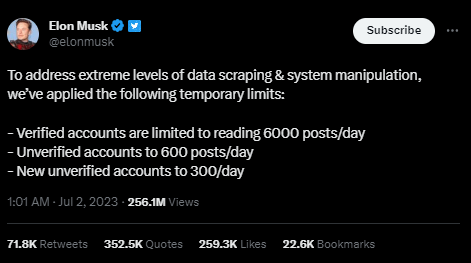
On July the 1st 2023, Elon Musk announced that he would be limiting the number of tweets that users could view per day, depending on the type of account they have. Verified accounts would be limited to reading 6,000 posts per day, unverified accounts to 600 posts per day, and newly created accounts to 300 posts per day. This limit was put in place to discourage “extreme levels of data scraping” and “system manipulation.”
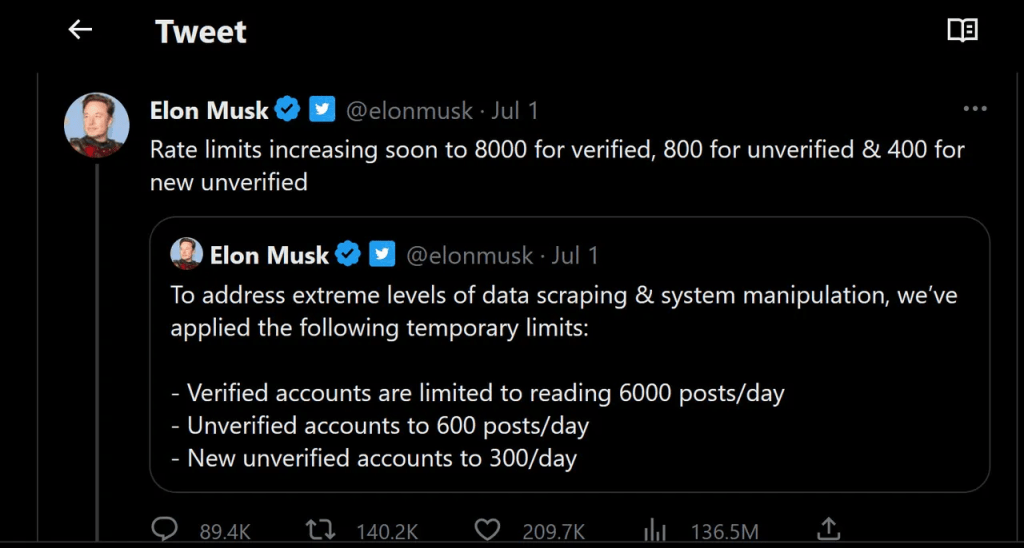
The limits were met with mixed reactions from users. Some users felt that the limits were too restrictive, while others felt that they were necessary to protect the integrity of the platform. Musk later raised the limits on the 3rd of July 2023 to 8,000 posts for verified accounts, 800 posts for unverified accounts, and 400 posts for newly created accounts.
If a viewer tries to view more tweets than their account allows, they will be shown a message that says “You have reached your limit for the number of tweets you can see. Please try again later.”, it is important to note that these limits only apply to the number of tweets that a viewer can see. Users can still create and post as many tweets as they want, regardless of their account type. Although these changes were enacted with good intentions—to focus on relevance and combat data misuse—they inadvertently opened a window of opportunity for Thread to excel.
Thread, with its unique premise of facilitating more personal, intimate interactions, seized this chance to distinguish itself. While Twitter limited the vast ocean of content users could dive into, Thread offered a refreshing counterpoint: a curated stream of communication within a trusted circle of contacts.
Unlike Twitter, Thread doesn’t impose viewing restrictions. Rather, it encourages meaningful, constant interaction among users. This freedom to converse without limits, provides a compelling alternative to Twitter’s newly constrained landscape.
This contrast between Thread’s unrestricted communication model and Twitter’s new limitations provides a unique selling point for Thread. It offers users the intimacy of meaningful interactions, unburdened by viewing restrictions, while still maintaining relevance—a combination that can resonate with users who value both privacy and freedom in their social media interactions.
In this landscape reshaped by Twitter’s viewing limitations, Thread has found a golden opportunity to position itself as an appealing alternative—a social media platform that understands the fine balance between user privacy, meaningful interactions, and unrestricted communication.
Musk vs Zuckerberg: The Unexpected Benefits of Rivalry
This face-off between Musk and Zuckerberg, encapsulated in the competition between Twitter and Thread, ignites more than just spectacle—it drives innovation. Their rivalry pushes both platforms towards continuous evolution, urging them to address their shortcomings and constantly enhance their user experiences.
From one perspective, this competition is a boon for consumers who stand to benefit from the ongoing quest for improvement. However, it also contributes to the increasing fragmentation of the social media landscape, potentially fostering more isolated communities within their respective platforms—an echo chamber effect that can polarize perspectives and narrow worldviews.
While fragmentation of the social platforms are valid concerns, they also prompt these platforms to keep innovating in ways that make social media more inclusive and representative. It’s a tricky balance to strike, but the stakes of this rivalry encourage both Thread and Twitter to strive towards creating platforms that respect user privacy, facilitate diverse conversation, and ultimately, serve as conduits for connecting our increasingly digital world.
Conclusion
As we navigate the uncharted waters of this exciting competition between Thread and Twitter, one thing remains certain: the landscape of social media is ever-changing, being shaped by the push and pull of innovation, user demands, and competition. The clash between Musk and Zuckerberg, encapsulated in the ongoing rivalry between Twitter and Thread, has catalysed a shift in how we perceive and engage with these digital platforms.
This rivalry between two tech titans, far from being just a spectacle, is a powerful driver of change and innovation. As Twitter and Thread continue to evolve and adapt in response to each other’s strategies and the shifting needs of their users, we, the consumers, are presented with a wider array of choices on how we want to connect and share in the digital age.
Thread’s integration with Instagram—while instrumental to its rapid user growth—poses questions around data privacy. Users’ concern arises from the fact that to delete their Thread account, they would need to delete their Instagram account as well. Such a move would sever not just one, but two digital lifelines—a hefty price to pay for wanting to disconnect from a single platform.
In this social media chess match, the real winners are the users. The power now lies in our hands—to choose, to shape, and to dictate the future of our digital interactions. As Twitter and Thread continue their journey, one thing is for certain, the dynamics of social media will continue to evolve. We eagerly watch as this exciting chapter of the digital age unfolds, knowing the path it carves will impact not just the industry, but society as a whole.
 Wondamo