
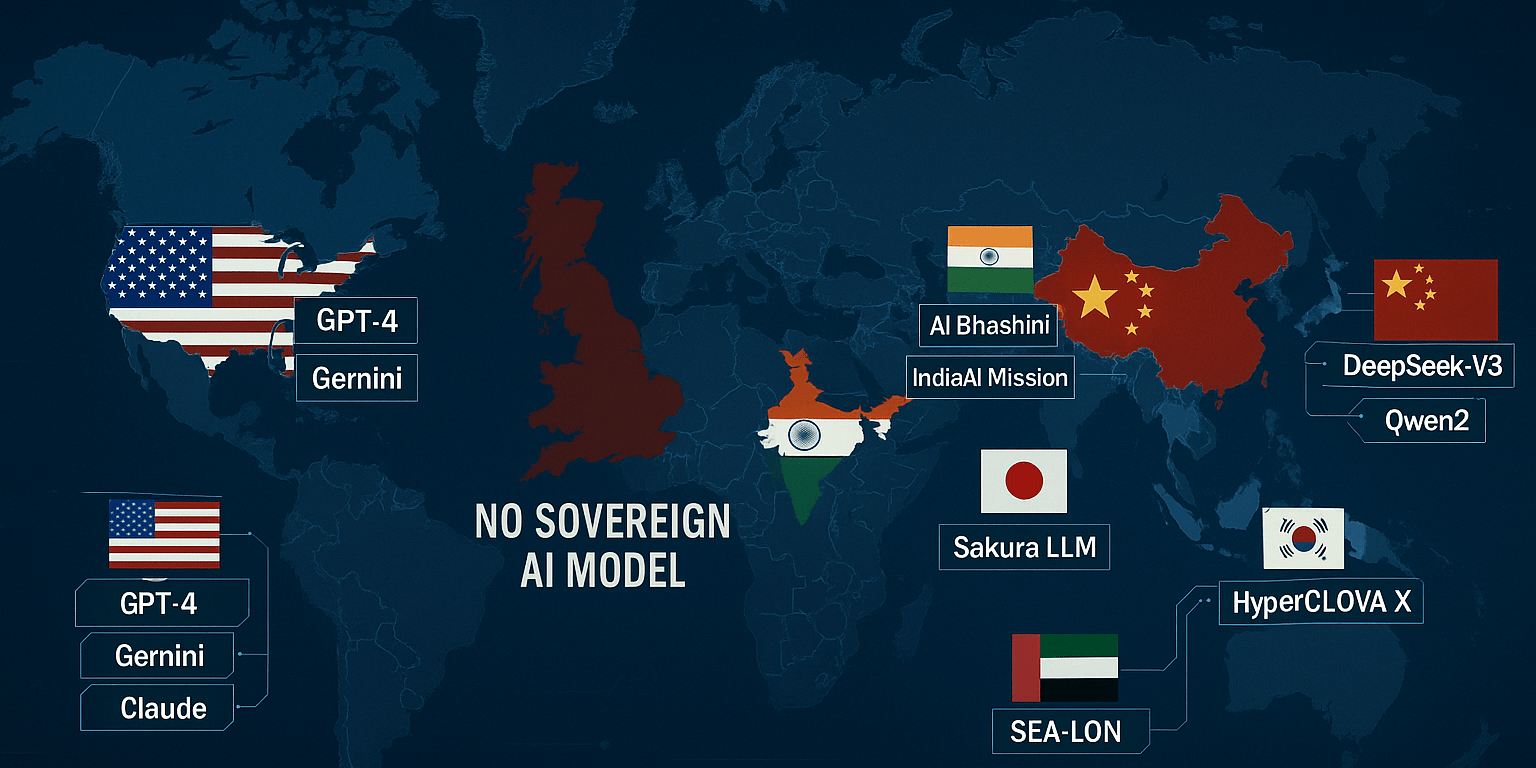
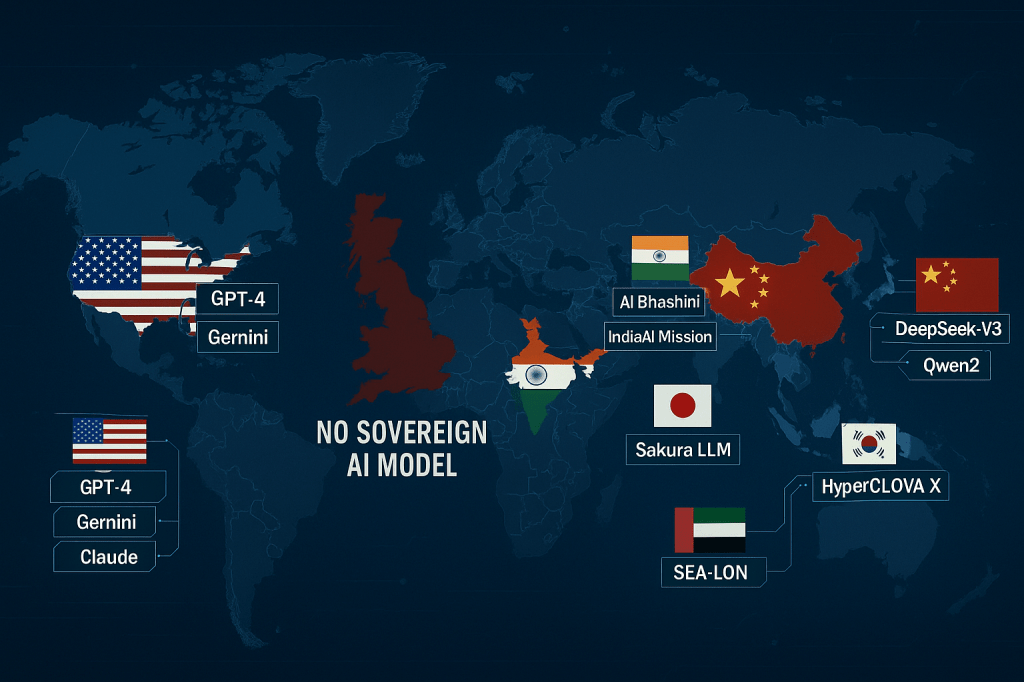
The United Kingdom stands at a critical juncture in the artificial intelligence revolution, facing an urgent choice between technological sovereignty and dangerous dependency. While the UK boasts the world’s third-largest tech sector valued at $1 trillion Wikipedia, this impressive figure masks a troubling reality: Britain has become dangerously dependent on foreign AI models, risking its strategic autonomy and economic future in an era where AI capabilities increasingly determine national power.
Current dependencies expose critical vulnerabilities
Britain’s AI landscape reveals stark dependencies that would make any strategic planner uncomfortable. UK organisations rely on US models for over 80% of their AI usage, with OpenAI’s GPT series, Google’s Gemini, and Anthropic’s Claude dominating enterprise and consumer adoption. Meanwhile, China’s DeepSeek R1 offers competitive reasoning capabilities at a fraction of Western costs, Newsweek and France’s Mistral AI has secured a €5.8 billion valuation by positioning itself as Europe’s sovereign alternative.
The UK government’s January 2025 AI Opportunities Action Plan, while promising £14 billion in private investment and 13,250 new jobs (Gov & Wondamo) fundamentally deepens these dependencies rather than addressing them. Unlike the EU’s push for digital sovereignty, Britain is “further entrenching its nation in Silicon Valley dependency” Tech Policy Press according to competition researcher Megan Kirkwood. Tech Policy Press. The UK’s £6.3 billion investment in US-owned data center infrastructure could become stranded assets if geopolitical winds shift.
Strategic risks mirror historical technology embargoes
Recent precedents demonstrate how quickly technological dependencies can become weapons. The Huawei 5G ban cost BT alone £500 million for equipment replacement, RCR Wireless News while creating new vulnerabilities by concentrating the UK’s telecommunications infrastructure among just two Nordic suppliers. Similarly, US AI export controls now create tiered access systems where even Tier 1 allies like the UK face compute allocation limits and must maintain “lockstep compliance” with Washington’s geopolitical priorities Sherwood News.
Expert analysis from RUSI and CSIS warns that the UK could be “stranded” through various scenarios: escalating US-China tech decoupling that forces binary choices, policy changes in Washington beyond London’s control, or Chinese retaliation targeting critical materials like gallium and germanium that China controls globally. The National Cyber Security Centre acknowledges that AI integration “will present new opportunities for adversaries” Gchq while developers prioritise speed over security.
Historical failures compound the urgency
Britain’s track record during previous technological revolutions offers sobering lessons about the costs of falling behind. During the dotcom boom, mobile revolution, and emergence of cloud computing, the UK consistently failed to develop major champions, instead becoming dependent on foreign platforms and infrastructure. These failures likely cost Britain 3-5% of potential GDP growth – hundreds of billions in lost economic opportunity.
Today, Amazon controls 30.1% of UK e-commerce with £26.4 billion in sales, City AM. Google and Facebook capture 62.7% of UK digital advertising revenue, and UK businesses pay billions annually to US cloud providers. The mobile revolution created hundreds of thousands of jobs in Nordic countries while Britain missed the opportunity entirely, now depending on Nokia, Ericsson, and previously Huawei for critical 5G infrastructure.
Global competitors surge ahead with sovereign strategies
While Britain debates, competitors act decisively. China has emerged as a formidable AI power, with Alibaba’s Qwen2 ranking #1 on Hugging Face’s open-source leaderboard CNBC and DeepSeek-V3’s 671 billion parameters competing directly with GPT-4. France committed €2.22 billion over five years and jumped from 13th to 5th place in global AI rankings. Japan pledged $740 million for sovereign AI infrastructure, while South Korea committed $6.94 billion to become a top-3 AI nation by 2030 Keia.
India’s $1.24 billion IndiaAI Mission targets 22 scheduled languages with 80+ million speakers each , while Singapore’s SEA-LION model outperformed GPT-4 Turbo on regional tasks despite being built by just 20 researchers on “academic rates” budgets Davoy. Even the UAE balances US and Chinese partnerships through G42’s $1.5 billion Microsoft investment while maintaining strategic autonomy Wikipedia.
The intelligence differential reshapes global order
AI is rapidly becoming what experts call “the differentiating factor of intelligence between nations.” PwC projects AI will contribute $15.7 trillion to global GDP by 2030 – equivalent to more than China and India’s current combined output. Countries with strong domestic AI sectors could see 26% GDP boosts, PwC while laggards risk economic marginalisation.
Beyond economics, AI determines military capabilities through “decision superiority on the battlefield,” Csis shapes soft power through platform dominance, and creates new forms of what the World Economic Forum terms “cyber-colonisation.” Nations controlling dominant AI platforms influence other countries’ citizens, gather intelligence, and set global standards for decades MIT Press.
Conclusion
The UK faces a stark choice: invest urgently in indigenous AI capabilities or accept gradual relegation to technological vassal status. History shows that missing technological revolutions carries generational costs. With AI’s impact potentially exceeding the industrial revolution itself, Britain cannot afford to repeat past mistakes. The time for half-measures and dependency has passed – the UK needs its own LLM capabilities to secure its future as a sovereign digital power.
 Wondamo