
A follow-up to Why the UK Needs a Sovereign AI Strategy Now, published ten months ago.
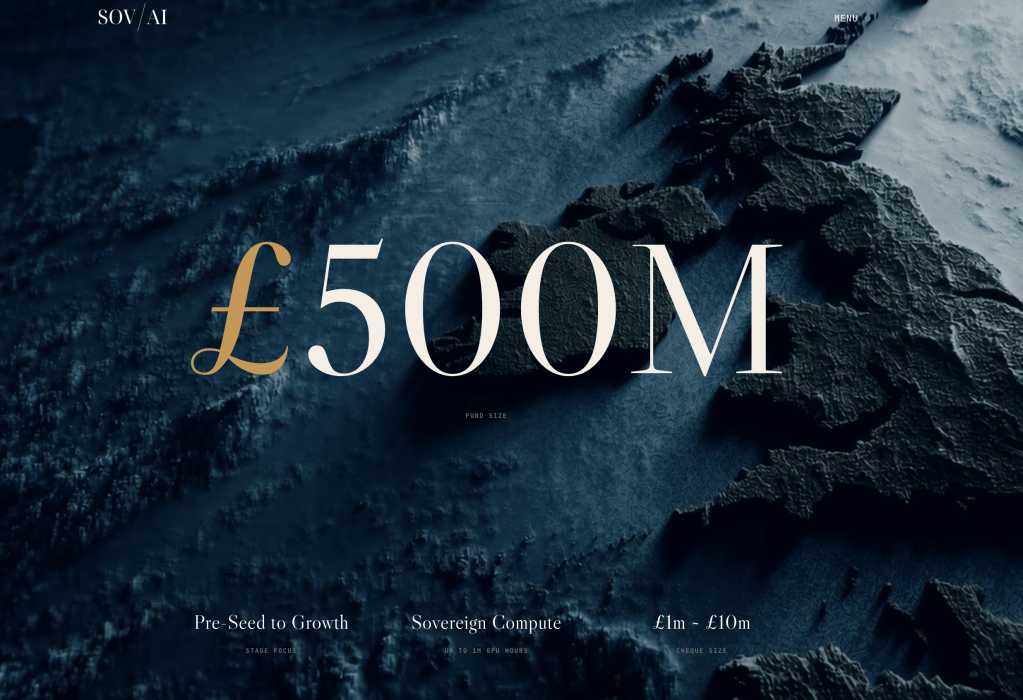
The Sovereign AI Fund, £500M committed, cheques from £1m to £10m, up to one million GPU hours per company. sovereignai.gov.uk
On Thursday 16th of April, the Tech Secretary Liz Kendall stood in Wayve’s King’s Cross headquarters and announced something the United Kingdom has been debating for the better part of three years. A £500 million, state-backed venture fund, named plainly, the Sovereign AI Unit, built to turn British AI research into British AI companies (GOV.UK).
It was a carefully chosen venue. Wayve is the closest thing Britain has to a sovereign AI success story in motion, a self-driving company that is backed by Mercedes-Benz, Nissan and Stellantis, and that counts all four of the world’s leading semiconductor companies among its partners. Kendall was not just launching a fund. She was standing inside a working proof point and saying, quietly, that Britain would like a few more of these, please.
Ten months ago on Wondamo, I wrote that the United Kingdom was running out of time to decide whether it wanted to be a sovereign AI power or a well-behaved customer of one. Over 80% of UK organisations’ AI usage sat on American foundation models. France had already put €2.22 billion on the table over five years, Japan $740 million, South Korea $6.94 billion. Britain had statements of intent and an AI Safety Institute. That was it.
The Sovereign AI Fund is the first serious reply with a focus on sovereignty.
What Kendall actually announced
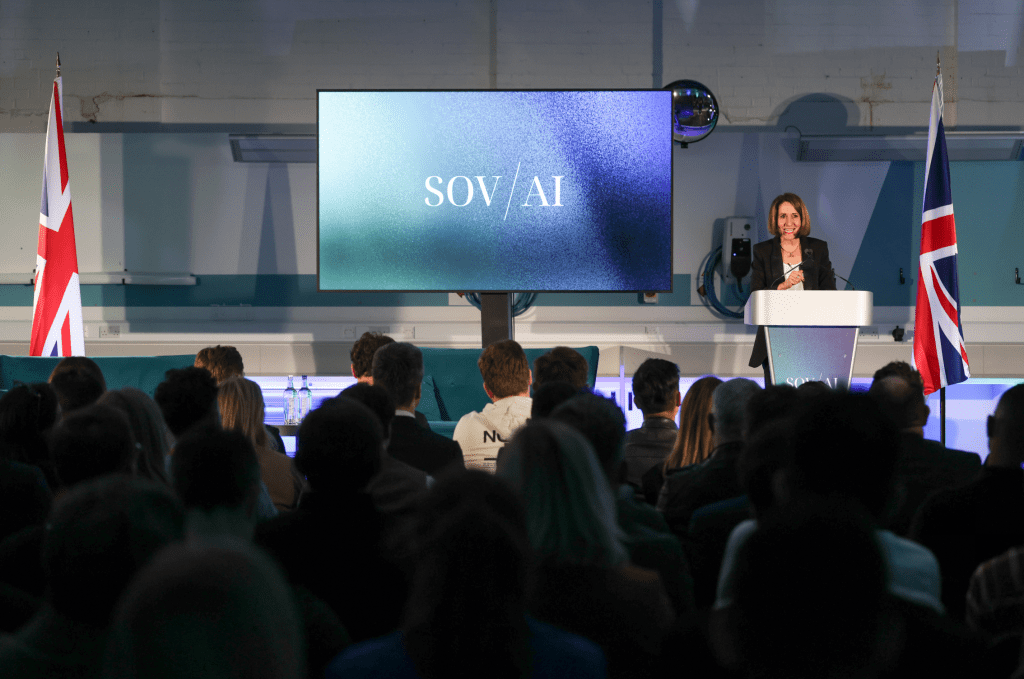
The room at Wayve’s King’s Cross headquarters, 16 April 2026. An OEM, Tier-1 and chipmaker audience as much as a Westminster one.
The Sovereign AI Unit is structured as a government-backed venture capital fund, not a grant scheme, not a research council, not a tax credit. That distinction matters. Innovate UK’s AI proof-of-concept competitions handed out shares of £1.6 million for technical demonstrators (iuk-business-connect.org.uk). The British Business Bank deploys patient capital through intermediary funds. Sovereign AI writes direct equity cheques into companies, with a right of first refusal on their next round.
The headline terms, drawn from the launch materials and GOV.UK’s release, are:
- Cheque size. Equity investments from roughly £1 million at pre-seed through to a stated ceiling of £10 million per company at growth stage (sovereignai.gov.uk).
- Compute. Up to one million GPU hours per startup on the UK’s AI Research Resource, the AIRR, which runs on the Isambard-AI supercomputer at Bristol and DAWN at Cambridge (sovereignai.gov.uk/compute-strategic-assets).
- Visas. Decisions inside one working day. Ten cost-free research-and-development visas per backed company. Legal fees covered to help foreign companies incorporate as UK Limited entities (GOV.UK speech).
- Access. Early government procurement as a customer, and direct routes through data-access and regulatory bottlenecks.
- Leadership. James Wise, a partner at Balderton, chairs the fund. Joséphine Kant, eight years at Google followed by Y Combinator and the launch of Dogwood Ventures, is Head of Ventures. Managing directors have not yet been announced (GOV.UK speech).
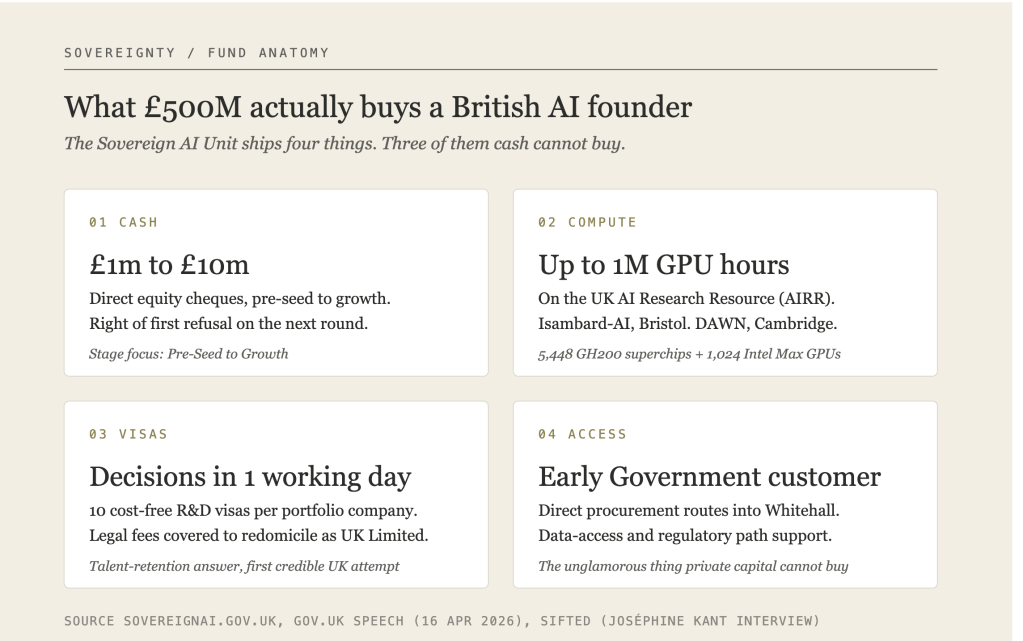
Anatomy of the Sovereign AI Fund. Four offers, three of which cash cannot buy.
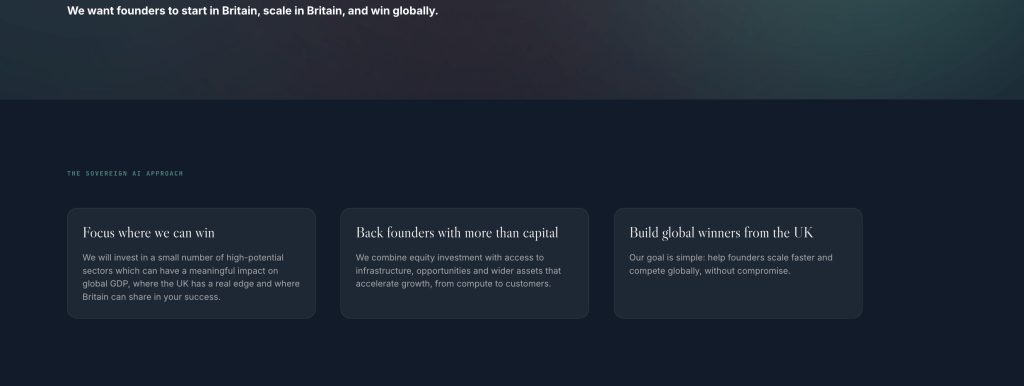
Start in Britain, grow in Britain, win from Britain. The Sovereign AI Unit’s own framing of the pitch, as published on sovereignai.gov.uk.
The first cohort: what the seven companies tell you
The fund announced its opening cohort on the same day: one equity investment and six compute agreements. Taken together, they are the Sovereign AI Unit’s working definition of strategic. None of them are generalist chatbot wrappers. Instead, the Unit has drawn a firm line around three sovereign pillars:
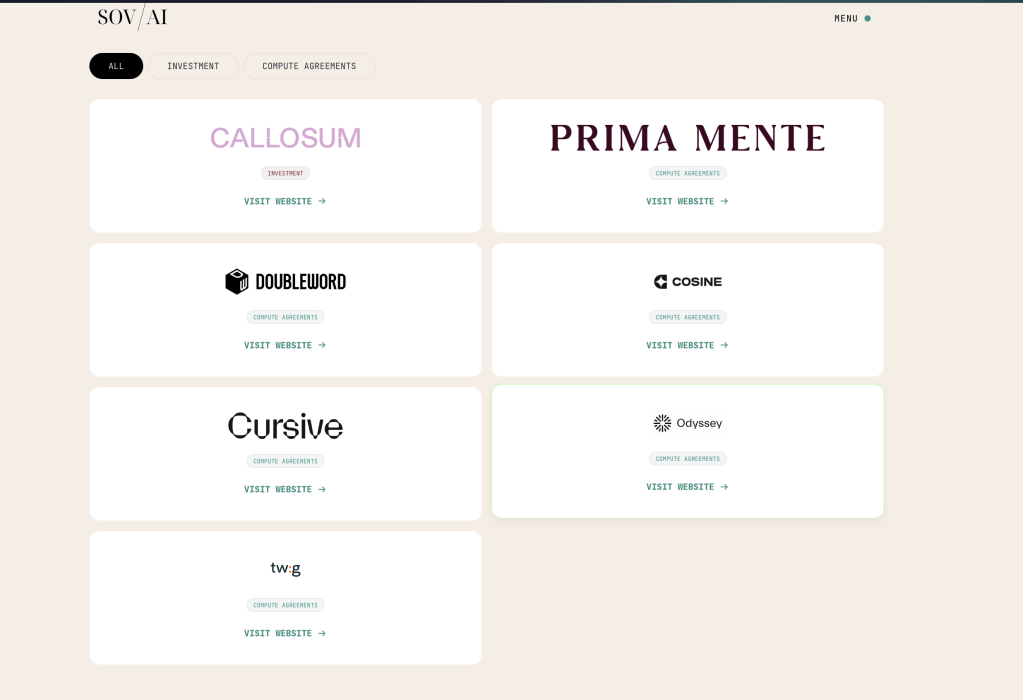
The first cohort.
1. Sovereign Infrastructure (Breaking the Monoculture)
- Callosum: Received the first equity investment. It builds software that orchestrates AI workloads across mixed silicon (Nvidia, AMD, AWS), extracting performance from each to avoid stack lock-in. The UK’s first sovereign cheque going to a company whose job is to break chip monoculture is not subtle.
- Cosine: Received 500,000 GPU hours. It runs coding models entirely inside a customer’s own infrastructure – no internet connection, no data leaving the building. It is the purest sovereign-coding play in Europe.
- Doubleword (formerly TitanML): Ships a self-hosted inference platform letting enterprises run AI models on their own hardware, a sovereignty play at the deployment layer.
2. Frontier Applied Science (The University Advantage)
- Prima Mente: Builds AI foundation models for neuroscience. Its “Pleiades” model has demonstrated up to a 97% success rate in detecting early-stage Alzheimer’s and Parkinson’s. Co-founded by researchers with ties to Oxford, Imperial, and Edinburgh, it is the clearest example of Britain’s university-to-company pipeline.
- Twig Bio: Developing a foundation model for AI-driven strain design in engineering biology and bio-manufacturing.
3. National Capability (AI for the State)
- Odyssey: Founded by autonomous vehicle veterans, building world models for defence, autonomous systems, and simulation.
- Cursive: Building autonomous agents, with founders drawn from Google DeepMind.
That is companies set the filter. Consumer AI is somebody else’s fund. It is also, quietly, the answer to the June 2025 question.
Does this solve the problem I named ten months ago?
Partially. And the partially is where the real argument lives.
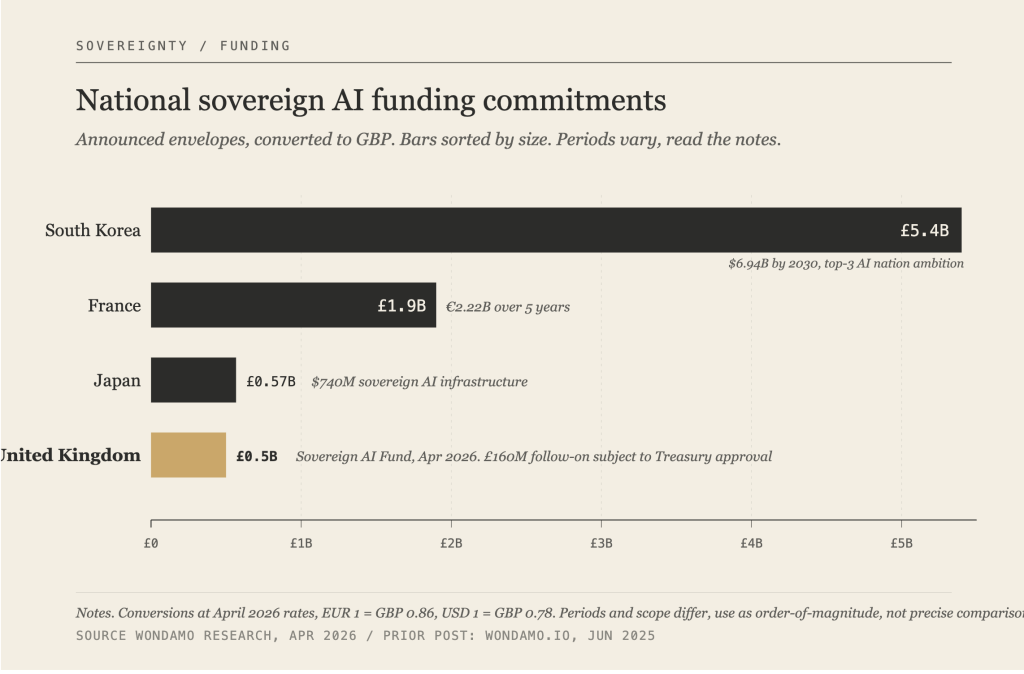
National sovereign AI commitments, converted to GBP at April 2026 rates. Periods and scope differ, read as order-of-magnitude. Sources in the June 2025 Wondamo post and recent research
The argument I made in June 2025 was that the UK had the ingredients of sovereignty (world-class universities, the third-largest tech sector globally, the most AI unicorns in Europe) and none of the plumbing (a credible domestic compute substrate, a talent-retention mechanism, a procurement pathway that let British firms compete to supply British government). The Sovereign AI Unit is the plumbing. That is a bigger deal than the cash.
Specifically:
- The AIRR, with Isambard-AI’s 5,448 Nvidia GH200 Grace-Hopper superchips in Bristol and DAWN’s 1,024 Intel Data Centre GPU Max GPUs in Cambridge, is now a real compute substrate that a British company can access without hiring a cloud-contract lawyer (UKRI).
- The one-working-day visa SLA is the first credible signal to a foreign founder that the UK is actually competing for them, not just marketing.
- The commitment to pay legal fees for foreign companies to redomicile as UK Limited entities is a small but sharp lever. It turns incorporation from a deterrent into a deliverable.
What the fund does not solve, on its own, is the retention problem for British founders once they have scaled. The fund is “unlikely to be enough to persuade would-be founders across the country to grow their business in the UK when capital gains and inheritance taxes remain so high.” Compute and cash address the first five years.
The second critique is scale. Five hundred million pounds is a real number in Whitehall. In the global AI race, where a single data centre can cost $122 billion and OpenAI is raising on a scale that would embarrass a sovereign wealth fund, £500M is a working capital line. One million GPU hours per company is generous against a pre-seed, it is a rounding error against a frontier pre-training run.
This is where the follow-on Strategic Assets Programme matters. The £160 million over four years, subject to Treasury approval, reads in context as the signalled commitment to keep going. If it arrives on time and scales, Sovereign AI is a programme. If it slips or shrinks, the fund becomes an expensive press release with a good first cohort attached.
The verdict
This is the most serious thing the UK has done on AI since the AI Safety Institute. It is the right vehicle, with roughly the right leadership, pointed at roughly the right founders, structured to move at roughly the right speed. It picks infrastructure, frontier science and national capability over consumer AI, which is the correct filter. It couples cash with the three things cash cannot buy, which is the correct design. It is housed at Wayve, which is the correct signal, however it is too small if it wants to compete on a global scale.
Five hundred million pounds, as a standalone number, is not sovereignty. It is a deposit. The sovereignty question is answered by what comes next. Whether the £160 million Strategic Assets Programme is approved and scaled, whether the Treasury writes the follow-on cheque that keeps this unit writing cheques of its own, whether the visa SLA survives a difficult immigration news cycle, whether capital gains and inheritance tax reform catches up to the founders the fund is supposed to retain. All of those are political, not structural. None of them are Joséphine Kant’s job.
The story is, as ever, the thing. Kendall closed with a line directed at British founders, that they are the country’s future and the Government will do everything it can to back them (GOV.UK). That sentence has been said, in different accents, in Paris, Seoul, Tokyo, Riyadh and Washington over the last 24 months. The difference will be in the follow-through, in the second cohort, in the Treasury approval, in whether the first Sovereign AI-backed Unicorn floats in London or Nasdaq.

