


A follow-up to last week’s piece on Britain’s £500M Sovereign AI Fund. Six working days ago, the fund was a fund. This week, it is on a cap table.
Introduction
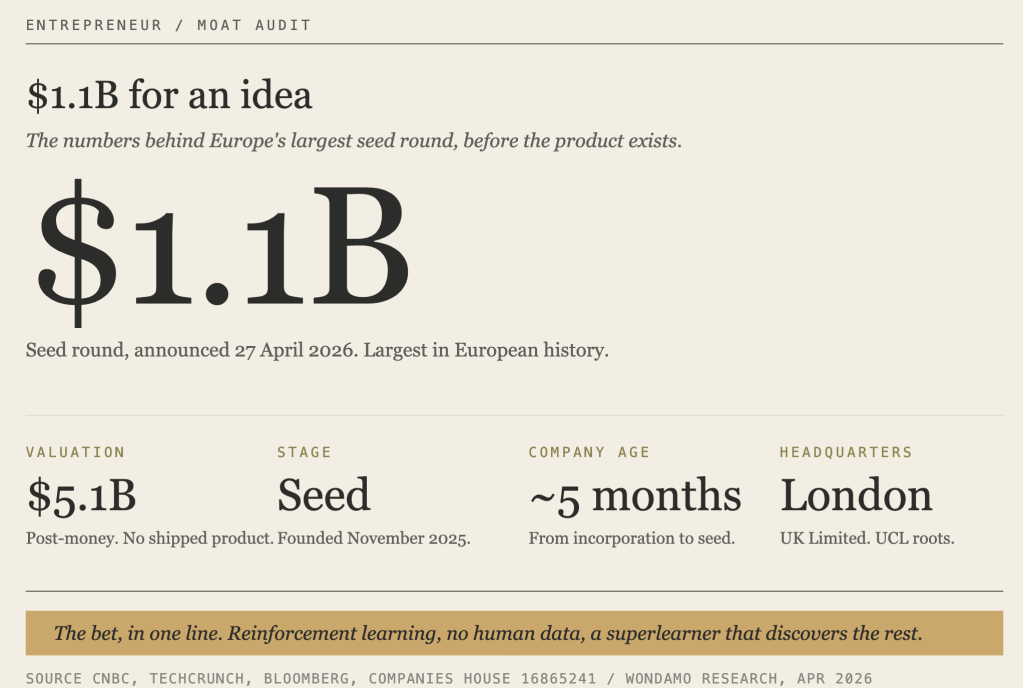
It seems that the UK is going all out in pioneering its own Sovereign AI future. Finding a way to generate new knowledge without relying on human knowledge, and the UK is betting big on this. On 27 April 2026, it was announced that Ineffable Intelligence had raised $1.1B at seed level at a $5.1B valuation, with the Sovereign AI Fund and the British Business Bank co-investing alongside Sequoia, Lightspeed, Nvidia and Google (Cooley, CNBC). Its promise? To move away from using pre-existing data, to designing systems that can interact with their environment, test ideas, and improve over time, allowing them to discover new solutions and insights on their own. Opening the door, in their words, to breakthroughs in science, medicine, engineering and beyond (ineffable.ai). Is this hype, or is this just another force in the motion of superintelligence?
Background
Ineffable Intelligence was registered on Companies House on 19 November 2025 (Companies House), founded by David Silver. For those that don’t know, David Silver (ex-DeepMind, AlphaGo, AlphaZero) is one of the most influential figures in modern AI. A Professor at University College London (UCL) and formerly Head of Reinforcement Learning at Google DeepMind, his work powered some of the biggest AI breakthroughs of the last decade, including AlphaGo, the system that famously beat the world champion at the game of Go (for reference, that is roughly 2.1×10^170 possible board positions, more than the number of atoms in the observable universe).
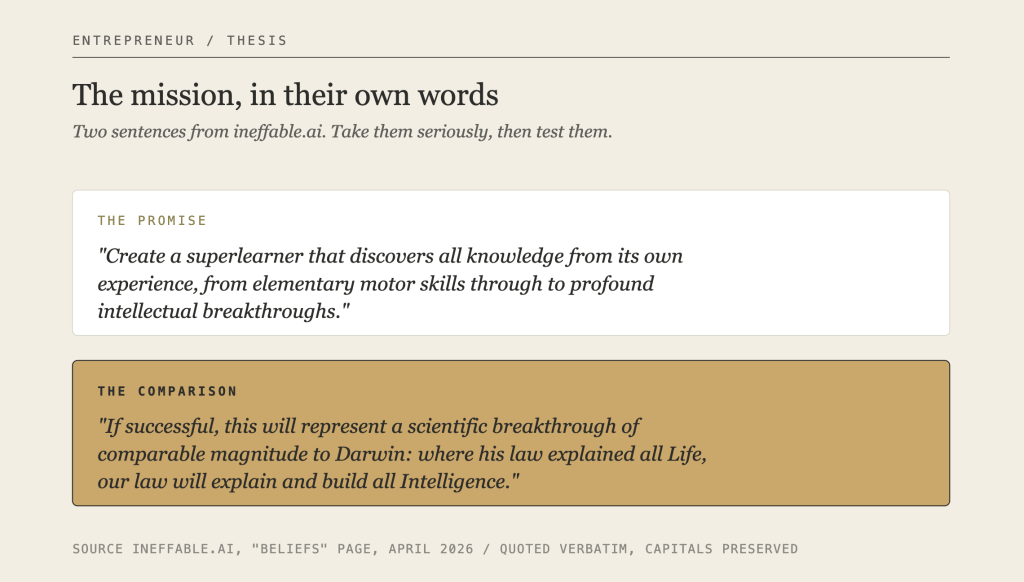
The goal of Ineffable Intelligence, I’ll coin it II, is Stage 2 of artificial intelligence, with a purpose, in their own words, to “create a superlearner that discovers all knowledge from its own experience, from elementary motor skills through to profound intellectual breakthroughs” (ineffable.ai). They believe that this is possible by utilising the most powerful reinforcement learning algorithm ever attempted at scale. And, if successful, they have claimed it will be of “comparable magnitude to Darwin: where his law explained all Life, our law will explain and build all Intelligence” (ineffable.ai – beliefs). Is that hyperbole, or is it something that can truly transform the future?
The thesis, explained
To understand what II is actually betting on, you have to read a paper. Not their pitch deck. The paper sitting underneath all of it is Welcome to the Era of Experience by David Silver and Richard Sutton, published in April 2025 as a chapter from the forthcoming MIT Press book Designing an Intelligence (DeepMind PDF). Sutton, for context, is the co-author of the field’s defining textbook on reinforcement learning, the godfather of the discipline, and the writer of the most quoted essay in modern AI, The Bitter Lesson (incompleteideas.net). When Silver and Sutton co-write something, it is the equivalent of two of the most senior people in the field telling you the next ten years are going to look different.
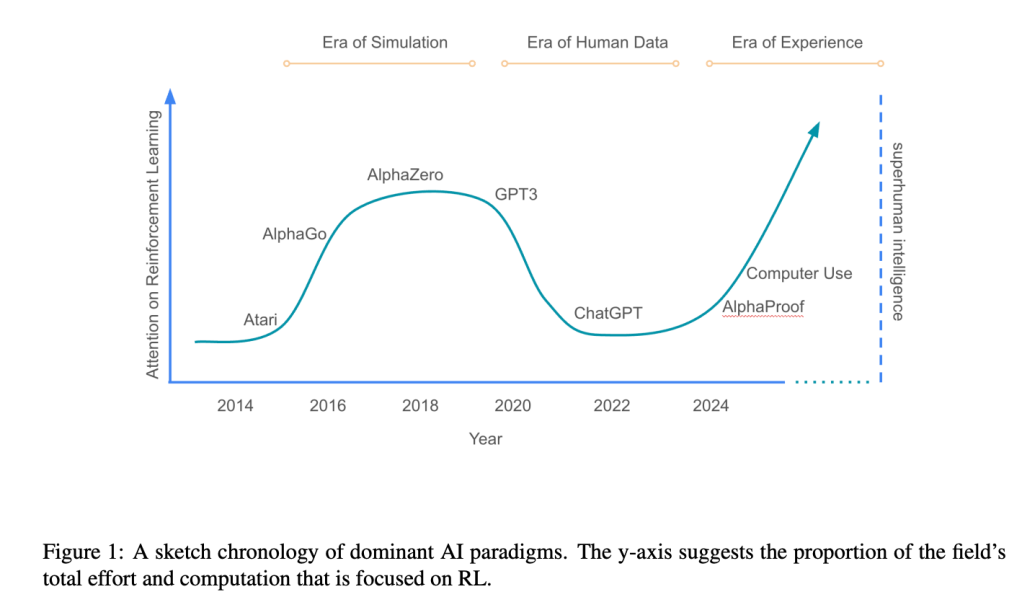
Source: DeepMind – Welcome to the Era of Experience
The Era of Simulation gave us AlphaGo and AlphaZero, agents that learned by playing themselves inside closed environments with clear rules. The Era of Human Data gave us GPT, Claude and Gemini, agents that learned by ingesting almost everything humans have ever written. They are extraordinary. They are also, in Silver and Sutton’s words, hitting a wall. “In key domains such as mathematics, coding, and science, the knowledge extracted from human data is rapidly approaching a limit” (Era of Experience paper). The internet, as a training corpus, runs out. And once it does, imitating the best of what humans wrote down stops producing better thinkers.
The Era of Experience is the answer they propose. Agents living inside live environments, doing things, getting feedback, and improving without a human in the loop.
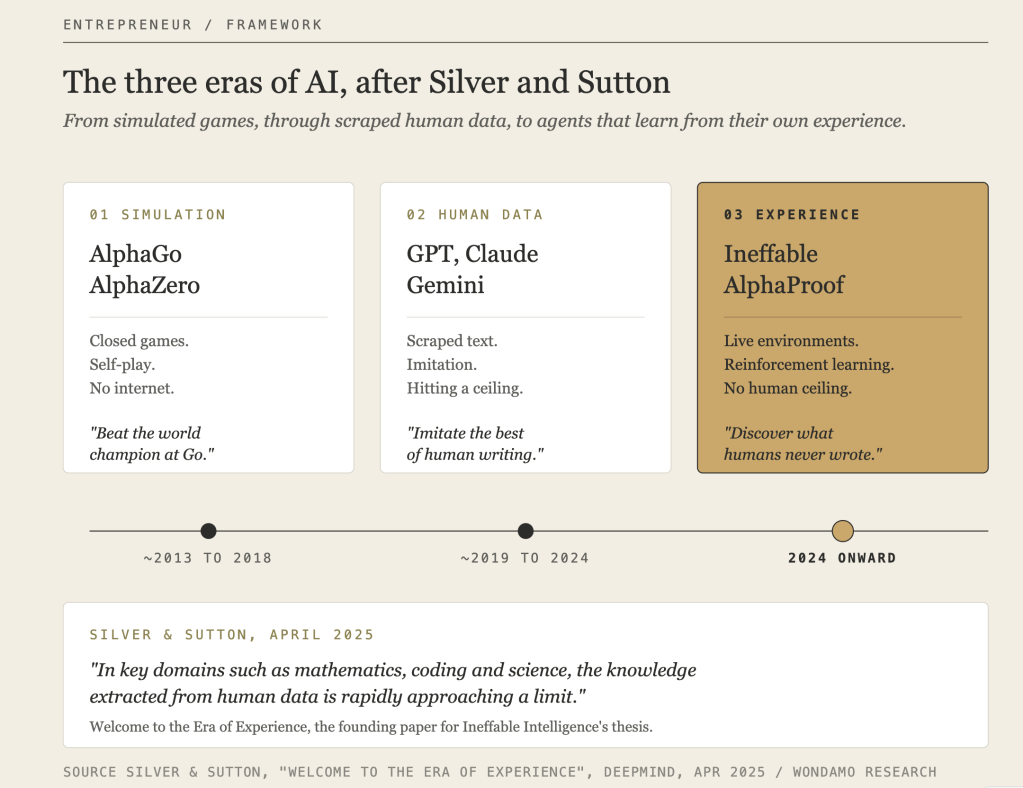
This is where reinforcement learning, the technique Silver has spent twenty years on, becomes the central engine of the bet. RL is how AlphaGo learned to beat Lee Sedol. It is how AlphaZero learned chess from zero in nine hours. It is how AlphaProof started solving olympiad-level mathematics problems no human had laid out a path through. The thesis is that the same technique, scaled up, generalised, and pointed at open-ended environments rather than closed boards, becomes the engine of general superintelligence. Sutton’s bitter lesson essay says, in one line, that “general methods that leverage computation are ultimately the most effective, and by a large margin” (incompleteideas.net). Ineffable Intelligence is a $5.1 billion bet that he is right.
I want to be careful here. This is not the consensus view inside frontier AI. Most of the running has been made by transformer-based language models trained on human data. OpenAI’s roadmap, Anthropic’s roadmap, Google DeepMind’s own production model line, all sit inside the Era of Human Data and continue to scale within it. Ineffable’s bet is contrarian by design. The company’s existence is a vote that the next breakthrough is not on that path.
The cap table, and what it actually says
The thing that fascinates me most about this raise is who showed up to write the cheque.
The round was co-led by Sequoia, with Alfred Lin and Sonya Huang, and Lightspeed, with Ravi Mhatre and Raviraj Jain (Pathfounders). Two of the most disciplined US growth-stage funds, underwriting a pre-product British company at seed. That alone would be a story. But the rest of the table is the story.
Nvidia bought a seat. So did Google, the company David Silver just left. DST Global, Index Ventures, BOND Capital, EQT Ventures, Flying Fish, Evantic Capital, the Wellcome Trust. Funds that almost never write cheques into pre-product seed rounds, all priced into a single seed round at a $5.1B post-money valuation (Tech.eu, Bloomberg).
And then the part that should be loud for anyone who read last week’s Wondamo piece. The UK Sovereign AI Fund is on the cap table. The British Business Bank is on the cap table, with $20 million committed of the round (CNBC). The fund I wrote about last Sunday, framed as the start of a programme rather than a finished one, has co-invested into Europe’s largest ever seed.
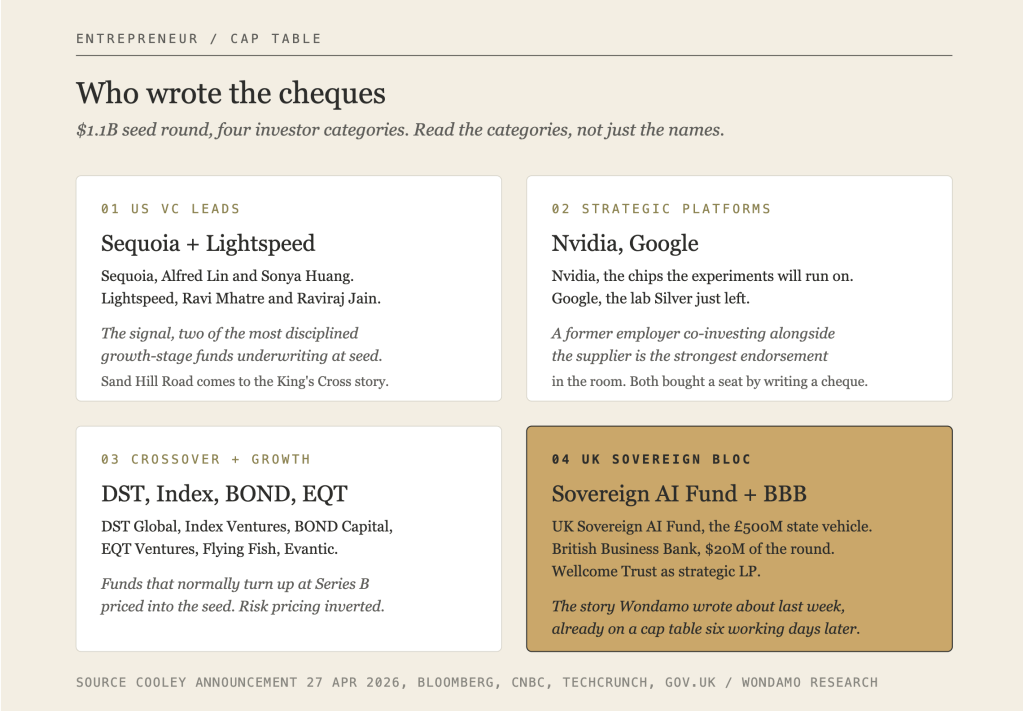
Three takeaways from that table.
- First, the smartest US capital is now writing cheques the size of European Series B rounds, at seed, into UK-headquartered companies. That is a meaningful repricing of the UK market. For years, British founders have been forced to fly to Sand Hill Road for the second cheque. Sequoia and Lightspeed putting their flagship fund money into a London company is a quiet reversal of the polarity.
- The Sovereign AI Fund’s first major signal is not who it is leading deals on. It is who it is willing to follow. Co-investing alongside Sequoia and Nvidia gives the fund signal-by-association without forcing it to make every primary judgement itself. That is sensible early-stage state-fund design. It is also exactly what last week’s piece argued the fund’s job was, to be the machinery, not the decider.
- Nvidia and Google being in the same round is the strongest possible alignment of supplier and incumbent. Nvidia gets a seat at a company that will buy a meaningful share of its compute. Google gets to be next to a thesis that, if it works, replaces a chunk of what they currently do. Both bought optionality. That is not endorsement, it is hedging at a price most companies cannot pay.
$5.1B for an idea
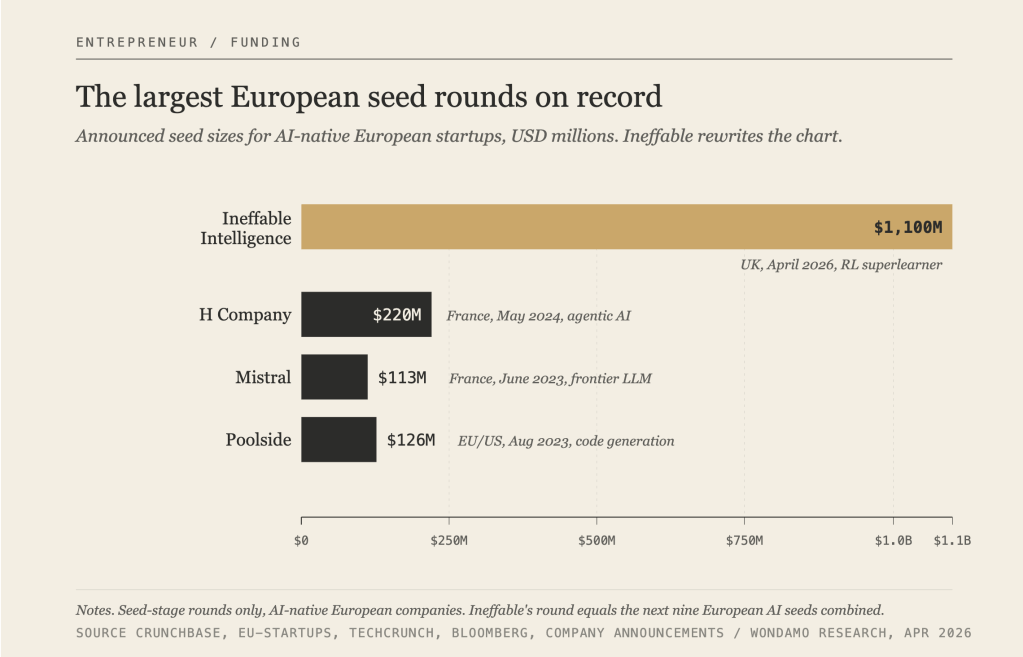
A $5.1B post-money seed valuation, before there is a product, before there is revenue, before there is a public benchmark, is not normal. By comparison, Mistral’s seed in 2023 was $113M. H Company, a French agentic-AI lab, raised $220M at seed in 2024. Poolside, the highest-profile European code-generation play, raised about $126M at seed in 2023. The next nine biggest European AI seeds, summed, are roughly the size of Ineffable’s single round (EU-Startups).
So what are the cheques actually buying?
The Era of Experience paper is not vapour. It is two of the field’s most senior researchers laying out, in writing, why the current paradigm hits a ceiling and what comes next. Investors are pricing the option that they are right. If they are, the company that owns the implementation owns the next era.
The UK’s benefit
This is a UK story that the British press has, on the whole, that hasn’t be caught up yet..
For the first time in a long time, the UK has a frontier AI lab that is not just a satellite office of an American company. Wayve, the self-driving lab the Sovereign AI Fund used as its launch venue, is one of the others. Cosine, in last week’s first cohort, is another. Ineffable now joins that very short list.
The Verdict: Hype or Superintelligence?
The honest answer is both. April 2026 will be remembered as either the peak of AI exuberance or the birth of a new physical law for intelligence. Here is the breakdown:
What is certain:
- Founder-Market Fit: David Silver isn’t just an “AI guy”; he is the primary architect of the systems that defined the last decade. His commitment to the Founders Pledge aligns his personal success with global benefit, a rare signal in a field of mercenaries.
- The Paper Trail: This isn’t a “vibes-based” startup. The Silver-Sutton thesis provides a rigorous, if contrarian, roadmap that moves beyond the plateauing returns of human-data imitation.
- The Signal: The cap table is a “Who’s Who” of global capital. It is the most significant endorsement of a British tech entity in history.
What remains unproven:
- The Credit Assignment Problem: Can $1.1B solve the fundamental math of rewarding specific actions in open-ended environments, the money buys Ineffable Intelligence a lot of attempts but not solutions.
- Sovereign Retention: Will the UK actually keep what it has funded, or is this just a taxpayer-subsidized exit for Silicon Valley?
- The “Bitter Lesson” Redux: We don’t yet know if the Era of Experience is the next great truth or a beautifully written dead end.
The Practical Translation
For those building or investing ths will be useful for you:
The Watch List: Watch for Ineffable’s first benchmarks. They will be the “Proof of Work” for the Era of Experience.
The European Price Floor: The “seed” stage has been fundamentally repriced. If you have a frontier thesis and a top-tier team, your valuation just gained an order of magnitude.
The “Follower” State: The UK Sovereign AI Fund has found its groove. By following lead investors like Sequoia rather than trying to dictate the market, the state is acting as a force multiplier for private capital.
Final Thoughts
Ten months ago I argued that the UK had to choose. Last week the choice arrived in fund form. This week it arrived in cap-table form. The bet is now placed. The next few years will tell us whether Britain bought a lottery ticket, or backed the law that explains intelligence.
Either way, this is a moment. Worth marking.
 Wondamo