
Introducing Financial Agent plugins
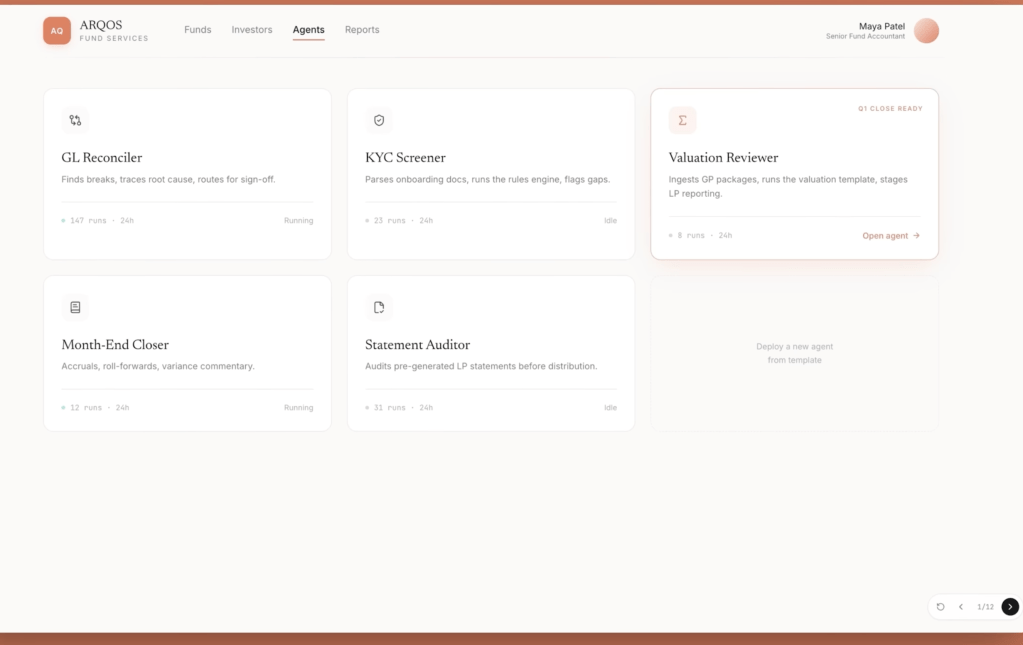
Anthropic just released another suite of plugins. This time, Financial Agent plugins. It seems like every week Anthropic is finding a new way to outdo themselves and take more market share away from their competitors. They must have a pipeline of features sitting in the backlog waiting to be released into the world. One thing is certain: they are coming after their next target HARD: the financial industry.
So what are these new plugins that have been released? How can businesses benefit from them? What makes them different from the plugins Anthropic had already released for finance? What makes these plugins beneficial?
Well, this is what we will try to delve into.
Not the first time Anthropic has targeted finance. So what has actually changed?
Back in July 2025, Anthropic launched their first financial services offering. At the time, it was a significant moment. It gave financial institutions access to Claude’s most advanced models, connected them to data providers like FactSet, S&P Global, Databricks and Snowflake, and expanded the context window so analysts could work through hundreds of pages of documents without losing continuity. It was genuinely useful, and firms like Bridgewater were already adopting it.
But here is the honest version of what it was: a powerful toolkit and not much more than that. Firms still had to figure out how to apply it to their specific workflows. Anthropic even bundled six weeks of implementation support, with Deloitte and KPMG involved, just to get firms up and running properly.
| July 2025 | May 2026 |
|---|---|
| General Claude models tailored for finance | 10 pre-built agents with specific job roles |
| Data connections provided, workflows built by you | Workflows already built, you customise and deploy |
| Required 6 weeks of implementation support | Deploy in days |
| Gave you the capability | Gives you the worker |
The May 2026 release closes that gap. Instead of giving firms a toolbox, Anthropic has pre-packaged the job roles themselves. The Pitch Builder already knows how to build a pitchbook. The KYC Screener already knows how to run a KYC file. The Month-end Closer already knows the checklist. You are not building on top of a model anymore. You are deploying something that already knows its job.
Key takeaways:
- Understand what the new Financial Agent plugins are
- Walk away with practical use cases for these
- Know how to differentiate between the previous releases and the new plugin
- Understand the benefits of these plugins
Financial Agents: a new plugin built to take on junior & mid-level roles
The Financial Agent release was announced on the 5th of May (as of writing, that was yesterday). The goal of these plugins is stated clearly: to act as a ready-to-run agent focused on work in financial services:
- Building pitchbooks
- Screening KYC files
- Closing the books at month-end
These are essentially targeted at repetitive tasks that already have a defined process. Pitchbooks already have processes with predefined, repetitive steps and templates for their designs, something that AI agents are good at now. Screening KYC files, as you can imagine, has the same characteristic, and so does closing the books at month-end. These are not cognitively difficult tasks once an analyst gets accustomed to the process. Businesses already do this, but manually and slowly. This is why Anthropic built these plugins: to speed up these time-consuming, repetitive tasks.
What makes this especially great for companies already taking advantage of Anthropic is that these can live within the financial company’s or financial team’s Claude Cowork or Claude Code seamlessly. They have already built the core layers used widely by all companies: Microsoft, which means PowerPoint, Excel, Word, and Outlook (coming soon). This means no new architecture, processes, connections, or platforms need to change; it only needs to be set up once. This is taken further with their MCP apps, so the agents draw on the data financial professionals already use, giving governed real-time access to their providers’ data. Note that one of their targets is to push Opus 4.7, as they claim this is the model that scores the best on Vals AI’s Finance Agent benchmark, scoring 64.37%.
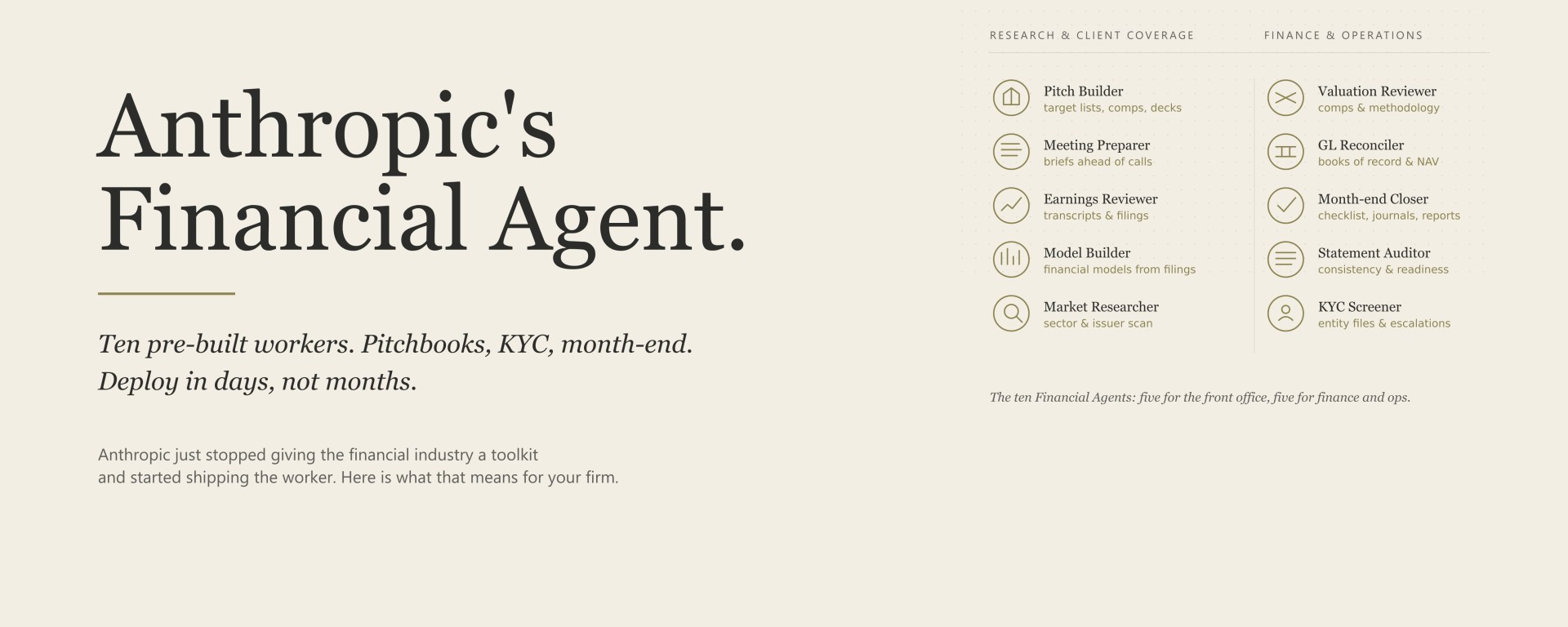
The full list of agents released falls into two brackets: Research and Client Coverage & Finance and Operations:
Research and Client Coverage
| Agent | Objective |
|---|---|
| Pitch Builder | Creates target lists, runs comparables, and drafts pitchbooks for client meetings |
| Meeting Preparer | Assembles client and counterparty briefs ahead of calls |
| Earnings Reviewer | Reads transcripts and filings, updates models, and flags thesis-relevant changes |
| Model Builder | Creates and maintains financial models from filings, data feeds, and analyst inputs |
| Market Researcher | Tracks sector and issuer developments, synthesises news, filings, and broker research, and flags items for credit and risk review |
Finance and Operations
| Agent | Objective |
|---|---|
| Valuation Reviewer | Checks valuations against comparables, methodology, and the firm’s review standards |
| General Ledger Reconciler | Reconciles general ledger accounts and runs net asset value calculations against the books of record |
| Month-end Closer | Runs the close checklist, prepares journal entries, and produces close reports |
| Statement Auditor | Reviews financial statements for consistency, completeness, and audit-readiness |
| KYC Screener | Assembles entity files, reviews source documents, and packages escalations for compliance review |
These templates are a starting point, not a finished product. Think of it like hiring a new analyst who already knows how investment banking works. You still need to show them how YOUR firm does things.
How can businesses benefit from this, and how?
First, to understand how businesses can benefit from this, we need to understand the anatomy of every agent that has just been released:
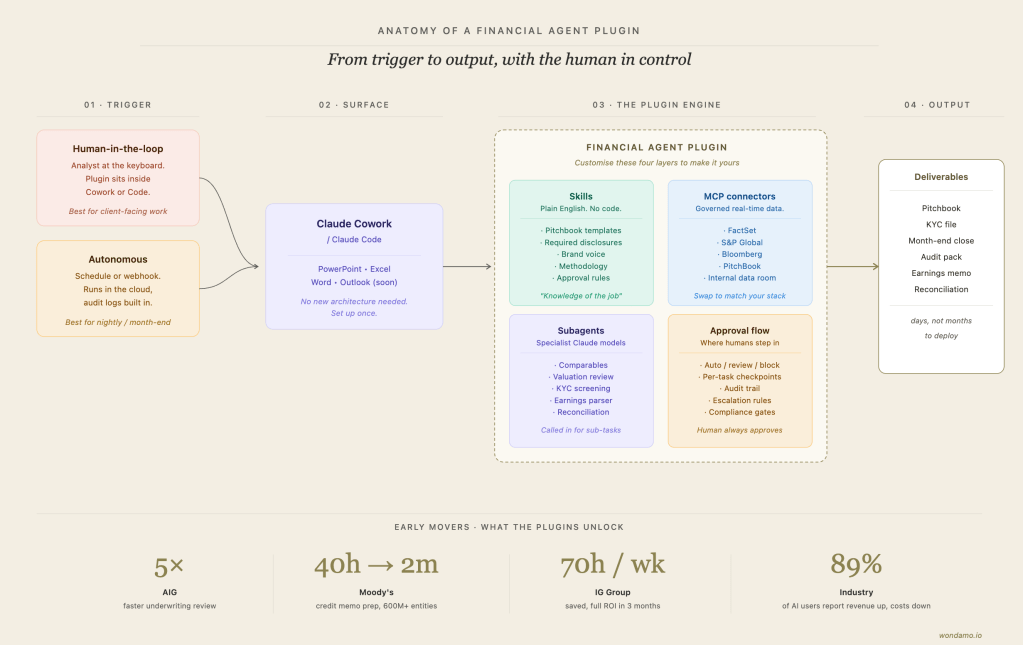
| What to customise | Why it matters |
|---|---|
| Your data connectors (MCPs) | The template ships with FactSet and S&P. You swap those for whatever your team actually uses: Bloomberg, PitchBook, your internal data room. |
| Your Skills | Written in plain English, no code. This is where you encode your methodology, required disclosures, and brand voice. |
| Your approval flow | You decide what the agent does autonomously and what needs a human checkpoint before it moves anywhere. |
| Your subagent instructions | The comparables subagent ships with generic methodology. Your firm has its own criteria, so you update it to match how your analysts actually work. |
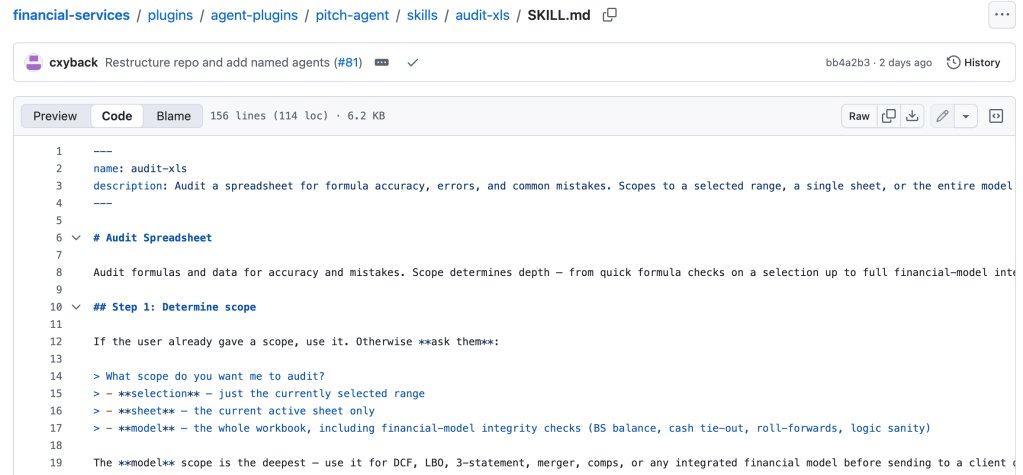
Example skill
Industry breakdown and use
| Industry | Where Finance Agent plugins fit |
|---|---|
| Investment banking & private equity | Pitchbooks, comps tables, CIM/teaser creation, LBO model analysis. Analysts spend most of their time on docs reviewed by senior bankers; Claude speeds up the drafting by hours. |
| Retail & commercial banking | Branch P&L reporting, policy/procedure lookup for frontline staff, deal origination pitches. Reduces underwriting turnaround and improves coverage ratios. |
| Wealth & asset management | Portfolio reporting, investment committee memos, performance decks, month-end close. Enables higher AUM per advisor and lower reconciliation error rates. |
| Insurance | Actuarial workbook review, regulatory filing slides, scenario & liability modelling. AIG compressed review timelines 5× and raised data accuracy from 75% to 90%+. |
There are two methods to use these
Human-in-the-loop: plugin in Claude Cowork / Code
The agent runs alongside the analyst. You review and approve every output before it moves anywhere. Best for deal work and client-facing docs.
Autonomous: Claude-managed agents
The agent runs on a schedule or trigger in the cloud. Nightly reconciliation, month-end close, bulk KYC screening. Full audit logs built in.
These aren’t chatbots. They’re pre-built workers you can configure and deploy on real financial workflows in days, not months. The human always approves before anything ships downstream.
How companies are already taking advantage
The numbers speak for themselves here. This isn’t theoretical, major institutions are already running these in production: JPMorgan Chase, Goldman Sachs, Citi, AIG, Visa. These aren’t companies that experiment for the sake of it.
| Company | What they’re doing | The result |
|---|---|---|
| AIG | Running Claude inside underwriting | 5× faster review timelines, accuracy up from 75% to 90%+ |
| Moody’s | MCP app pulling from a 600M+ entity database | Credit memo prep down from 40 hours to 2 minutes |
| IG Group | AI-assisted analytics and query handling | 70 hours saved per week, full ROI in 3 months |
Source: Anthropic, Claude for the Financial Industry: A Practical Deployment Guide & NVIDIA State of AI in Financial Services Survey 2026, cited in Anthropic Deployment Guide.
Zooming out, a 2026 NVIDIA survey found that 89% of financial services firms using AI reported it increased revenue while lowering costs. The industry isn’t sitting around debating whether this works anymore. The early movers have already answered that question.
Where does this leave businesses?
The honest answer is that most businesses will not move on this immediately, and that is fine. The ones that will get the most out of this are firms that already have their processes defined, know what their analysts spend most of their time on, and have at least one person internally who is willing to champion the rollout. Without that, even the best template in the world sits unused.
What Anthropic has done here is remove the biggest barrier to adoption, which was the build time. You are no longer starting from scratch. The job roles exist, the workflows are packaged, the data connections are there. What is left is making it yours.
That is exactly where Wondamo comes in. Whether you are figuring out which agent to start with, mapping it to your existing process, or working out what your Skills and approval flow should look like, we help businesses think through the strategy before they touch a single template. Getting the setup right the first time saves months of going back and forth.
We are also putting our money where our mouth is. Over the coming weeks, we will be publishing a full end-to-end walkthrough of one of these agents running on a real workflow, from the raw template through to a customised, deployed version. So if you want to see exactly what this looks like in practice before committing to anything, that is coming.
Follow along and feel free to reach out if you want to talk through what this could look like for your business specifically.

