
Are you tired of interacting with chatbots that seem robotic and lack human-like understanding? Meet ChatGPT, the new language model developed by OpenAI that has the ability to generate human-like text in real-time. Designed for use in chatbots, messaging apps, understanding code and even writing complex codes. ChatGPT has the potential to revolutionize the way we interact with artificial intelligence. In this blog post, we’ll take a closer look at ChatGPT and its various capabilities, and how it has the potential to improve the effectiveness and efficiency of chatbots and we will also delve into the issues ChatGPT presents.
How ChatGPT Was Created: The Story of Its Development
ChatGPT was developed by OpenAI, a leading research organization focused on artificial intelligence. It is not clear exactly when the development of ChatGPT began, as OpenAI does not publicly disclose specific dates for the development of its projects. However, OpenAI was founded in 2015, so it is likely that the development of ChatGPT took place sometime after the founding of the organization.
OpenAI was founded by a group of high-profile tech industry leaders, including Elon Musk, Sam Altman, Greg Brockman, Ilya Sutskever, John Schulman, and Wojciech Zaremba. It is likely that these individuals played a key role in the development of CHATGPT and other projects at OpenAI.
Overall, the development of CHATGPT was a complex and highly technical process that likely involved a large team of researchers and engineers working over an extended period of time. It is a testament to the capabilities of OpenAI and the advancements in natural language processing and machine learning that have been made in recent years.
ChatGPT in Action: Real-World Examples of Its Capabilities
CHATGPT can be used in a variety of applications, including chatbots, messaging apps, customer service platforms, and virtual assistants. It can be used to handle simple queries and requests, or to engage in more complex conversations with users. Some potential use cases include:
- Customer service chatbots: ChatGPT has been used to power customer service chatbots for businesses in a variety of industries. For example, a clothing retailer could use ChatGPT to power a chatbot that helps customers find products, place orders, and track their shipments.
- Virtual assistants: ChatGPT has also been used to power virtual assistants, such as voice assistants or chat-based assistants. For example, a company could use ChatGPT to power a virtual assistant that helps employees schedule meetings, answer questions, and perform other tasks.
- Educational platforms: ChatGPT has been used in educational platforms that use chat-based interactions to teach students. For example, a language-learning platform could use ChatGPT to power a chatbot that helps students practice their speaking and writing skills.
- Social media and messaging apps: ChatGPT has been used to power chatbots and virtual assistants in social media and messaging apps. For example, a messaging app could use ChatGPT to power a chatbot that helps users find information, make recommendations, or perform other tasks.
- Code generation and understanding: ChatGPT has the ability to write and understand code in various programming languages. This allows it to assist developers in writing and debugging code, as well as perform tasks such as code completion and suggestion. This can significantly improve the efficiency and productivity of developers, as well as reduce the risk of errors and bugs in the code.
These are just a few examples of how ChatGPT has and can be used in real-world. As chatbot technology continues to evolve, it is likely that ChatGPT and other language models will be used in even more innovative and varied ways.
For demonstration purposes, I asked ChatGPT to generate a Python script for web scrapping. It was given a simple prompt, and the resulting script is shown below.
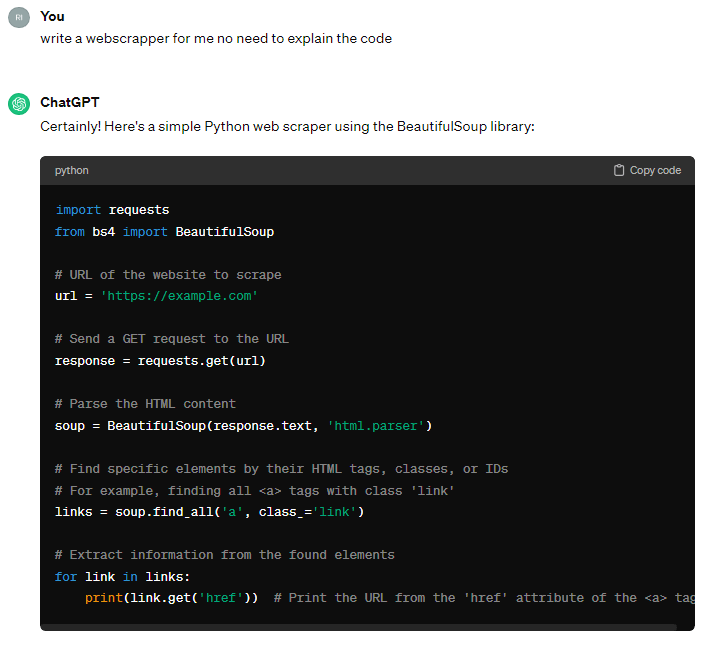
The power of ChatGPT is evident in its ability to generate human-like code in real-time. It has the potential to benefit society in a number of ways. However, we must also consider how ChatGPT could potentially impact the way society functions in the future.
The Potential Downsides of ChatGPT
While ChatGPT has the potential to bring many positive benefits to society, it is also important to consider potential negative impacts. Some potential negative impacts of ChatGPT on society include:
- Displacement of human workers: As ChatGPT and other advanced language models become more widespread, they could potentially displace human workers in customer service and other industries where they are used. This could lead to job loss and economic challenges for affected individuals.
- Misuse or abuse: As with any technology, there is the potential for ChatGPT to be used for malicious purposes. For example, it could be used to spread misinformation or to engage in cyberbullying or other forms of online harassment.
- Lack of accountability: As a machine, ChatGPT does not have the same moral or ethical considerations as a human. This could lead to situations where it generates inappropriate or offensive content, and there may be no one to hold accountable for these actions.
- Privacy concerns: ChatGPT and other language models rely on access to large amounts of data, including personal information and conversations. This raises concerns about data privacy and the potential for this information to be misused or abused.
It is important to consider and address these potential negative impacts as we continue to develop and use ChatGPT and other advanced language models. This may involve developing guidelines and regulations for the use of these technologies, as well as investing in retraining and other support for workers who may be affected by automation. By taking a proactive and responsible approach, we can ensure that the benefits of ChatGPT and other advanced language models are maximized while minimizing any negative consequences.
The Future of ChatGPT : How This AI Chatbot Could Change the World
CHATGPT is a groundbreaking language model developed by OpenAI that has the ability to generate human-like text in real-time. Its advanced capabilities make it a valuable asset for a wide range of applications, including chatbots, messaging apps, and other conversational interfaces. ChatGPT has the ability to adapt to new contexts and generate responses that are similar to those of a human, which makes it a powerful tool for customer service, virtual assistants, and other applications that require natural language processing.
In addition to its ability to generate text, ChatGPT also has the ability to perform various language-related tasks, such as translation, summarization, and question answering. This makes it a versatile and powerful tool that can be used in a wide range of applications.
However, it is important to use ChatGPT and other advanced language models responsibly and ethically. This may involve considering the potential negative impacts of the technology, such as the potential for misuse or the impact on employment, and taking steps to mitigate these risks.
As the technology continues to evolve, we can expect to see even more innovative uses for ChatGPT in the future. Its ability to generate high-quality, human-like text in real-time makes it a valuable asset for a variety of industries and applications. The potential for ChatGPT to revolutionize the way we interact with artificial intelligence is vast, and we can look forward to seeing it continue to make an impact in the years ahead.
Thanks for reading.
 Wondamo
Great work
LikeLike